
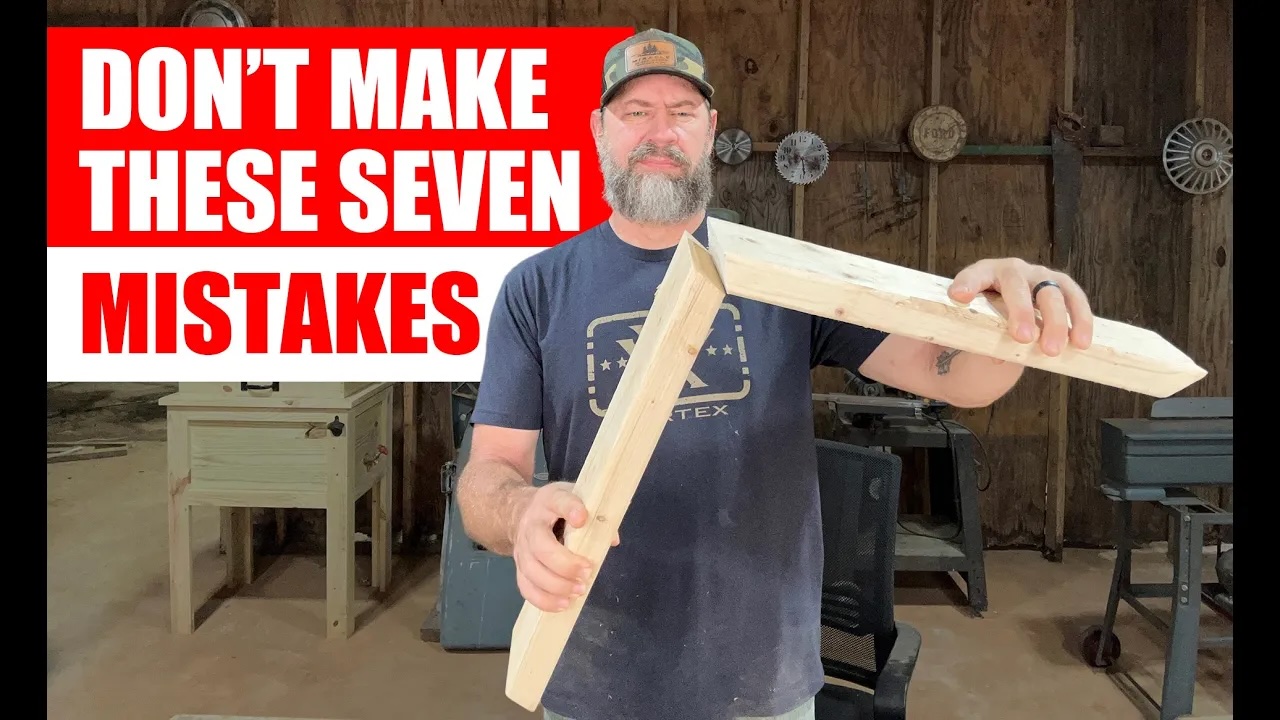
7 Common Beginner Woodworking Mistakes I’ve Made More Than Once
If you’re new to woodworking, let me save you some frustration right up front:
You’re going to make mistakes.
I don’t say that to discourage you. I say it because it’s just part of the deal. Woodworking has a way of humbling you pretty quick, especially when you’re just getting started.
I know because I’m still very much a beginner woodworker myself, and I’ve made every single one of the mistakes on this list. Some of them more than once.
So this isn’t coming from a master craftsman looking down from the mountaintop. This is coming from a regular guy who is learning as he goes, building projects, messing things up, fixing what he can, and trying to get a little better every time.
My hope is that by sharing these common beginner woodworking mistakes, maybe you can avoid a few of them yourself — or at least recognize them sooner when they start causing problems in your projects.
And if nothing else, maybe you’ll feel a little better knowing you’re not the only one who has measured wrong, rushed a finish, or wondered why your supposedly square cut wasn’t square at all.
1. Starting With Poor Quality Materials
One of the first mistakes beginner woodworkers make is starting a project with poor quality materials.
And no, I’m not saying you need to build everything out of expensive hardwoods.
There is absolutely nothing wrong with using construction lumber, cedar fence pickets, plywood, pine boards, or whatever material makes sense for your project and your budget.
I use a lot of cedar fence pickets myself. They’re affordable, easy to find, and great for outdoor projects like planter boxes, bird feeders, and small builds.
But even when you’re using budget materials, you still need to take the time to pick through the pile and find the best boards you can.
Look for boards that are:
- Straight
- Not badly twisted
- Not split
- Not cupped or crowned too badly
- Free of knots in problem areas
- Close to the look and grain pattern you want
Cedar fence pickets, especially, can be bad about having a crown or being bowed. Construction lumber can be just as bad.
It takes a little extra time to dig through the stack at the store, but it’s worth it.
If you start with bad material, you’re going to fight it the whole way through the project. And in a lot of cases, poor quality material leads to a poor quality finished product.
A good project starts before you ever make the first cut.
It starts with choosing better boards.
2. Not Calibrating Your Tools
This is one I definitely learned the hard way.
When you buy a new saw, it’s easy to assume it’s square and ready to go right out of the box.
Sometimes it is.
Sometimes it isn’t.
And if you buy a used tool, like I’ve done with several of mine, you really have no idea how well it’s set up until you check it.
Your table saw, miter saw, and other cutting tools need to be calibrated if you want accurate cuts. If your blade isn’t square, your fence is off, or your miter gauge isn’t reading correctly, your project can go sideways fast.
That can lead to a lot of frustration because you’ll think you’re doing everything right, but your pieces still won’t fit the way they should.
Take time to check:
- Whether your blade is square to the table
- Whether your fence is aligned correctly
- Whether your miter saw is actually cutting at 90 degrees
- Whether bevel and angle settings are accurate
- Whether your gauges and stops are reading correctly
Read the manual. Watch a few setup videos. Use a reliable square. Make some test cuts.
It may feel like a boring step, especially when you’re excited to start building, but it can save you a pile of headaches later.
3. Using Dull or Cheap Blades and Bits
Trying to save a few bucks on cheap blades and drill bits can cost you more frustration than it’s worth.
I’ve been guilty of this one too.
When you’re just getting started, it’s tempting to buy the cheapest blades, cheapest drill bits, and cheapest accessories you can find. I get it. Woodworking tools and supplies add up fast.
But dull or poor-quality blades and bits can cause all kinds of problems.
They can leave rough cuts, burn marks, tear-out, wandering holes, chipped edges, and more cleanup work than you should have to deal with.
A dull blade doesn’t just make your project look worse. It can also make your tools work harder and make cuts less safe.
That doesn’t mean you have to buy the most expensive blade on the shelf. But it does mean you should buy decent blades and bits for the type of work you’re doing.
And once you have them, take care of them.
Keep them sharp. Clean them when needed. Replace them when they’re worn out.
A better blade can make a cheap saw perform a whole lot better.
4. Not Measuring Twice and Cutting Once
There’s a reason woodworkers say, “Measure twice, cut once.”
It’s because every one of us has measured once, cut once, and then stood there staring at a board that was too short.
This is probably one of the most common woodworking mistakes there is.
It’s easy to get in a hurry and misread a tape measure. Maybe you’re off by 1/16 inch. Maybe you’re off by 1/8 inch. Or maybe you read 26 3/4 inches when it was actually supposed to be 27 3/4 inches.
Ask me how I know.
When you’re measuring and marking, slow down.
Take a good measurement. Double-check it. Transfer it carefully to your board. Then make sure you’re cutting on the correct side of your line.
And if the fit really matters, don’t be afraid to cut a piece slightly long and creep up on the final fit.
You can always take a little more off.
You can’t put it back on.
5. Skipping Test Cuts
This one has made a big difference for me.
Once I finally built up a decent scrap pile, I started using scrap wood for test cuts. That has helped me improve the quality of my projects and avoid ruining good material.
If I’m making a miter cut, bevel cut, angle cut, special joint, or anything I’m not 100% confident in, I’ll often test it on scrap first.
That lets me check:
- Whether the angle is right
- Whether the saw is cutting cleanly
- Whether the pieces fit together correctly
- Whether the setup needs adjusting
- Whether I misunderstood the cut completely
Yes, it adds an extra step.
But that extra step can save you from messing up the actual piece you need for the project.
Test cuts are especially useful when you’re still learning your tools. They let you work out the bugs before it counts.
6. Comparing Yourself to Other Woodworkers
This is a big one, especially now with YouTube, Instagram, Facebook, and all the other places where people are posting polished projects from perfect-looking shops.
It’s easy to watch another woodworker and think:
“Why can’t I do that?”
“When will I be that good?”
“How is his shop that clean?”
“How did that guy build that so fast?”
I’ve done it too.
I watch a lot of woodworking videos, and it’s easy to compare my beginner projects to somebody who has been doing this for years.
But that’s a trap.
There’s nothing wrong with wanting to improve. There’s nothing wrong with being inspired by better woodworkers. That’s how we learn.
But don’t let comparison steal the fun from the process.
You don’t know how long that person has been woodworking. You don’t know how many mistakes they made before the camera turned on. You don’t know how many tools, years, failures, and redo’s are behind that finished project.
The only comparison that really matters is whether you’re getting better from one project to the next.
That’s the race.
And it’s only with yourself.
7. Letting Perfectionism Stop You
Perfectionism sounds like a good thing at first.
After all, you want to do good work. You want your projects to look nice. You want tight joints, clean cuts, smooth finishes, and something you’re proud to show people.
But perfectionism can also slow you down, frustrate you, and make you feel like every project is a failure just because it isn’t flawless.
Here’s the hard truth:
Woodworking projects are rarely perfect.
Especially beginner woodworking projects.
Wood itself isn’t perfect. Boards move. They warp. They have knots, grain issues, cracks, and imperfections. Then you add human error on top of that, and things are bound to happen.
That doesn’t mean you should be sloppy.
You should absolutely try to do your best work. You should care about quality. You should fix what needs fixing and learn from what went wrong.
But don’t expect flawless.
Expect progress.
Do the best you can on the project in front of you, learn what it teaches you, and carry that lesson into the next one.
8. Rushing Through the Project
I know I said this was seven mistakes, but honestly, this one ties so many of the others together that it deserves its own section.
Rushing is probably the mistake that causes the most damage.
And I am bad about this one.
Especially near the end of a project.
You start seeing the light at the end of the tunnel. You’re excited to show it to your wife, post it on Facebook, share it on YouTube, or just finally be done with the thing.
So you rush.
You rush the sanding.
You rush the stain.
You rush the finish.
You rush the assembly.
And that’s usually when you mess something up.
Rushing can also show up at the beginning of the project. You skip calibrating the tool. You don’t check your measurement. You don’t make the test cut. You grab the first board off the pile instead of finding a better one.
All of those little shortcuts cost you quality.
Slow down.
Take your time.
Focus on accuracy and precision. Make the test cut. Check the fit. Sand a little longer. Let the finish dry. Read the directions. Walk away for a few minutes if you’re getting frustrated.
Woodworking is not a race.
Most of the time, slowing down is what makes the final project better.
Final Thoughts
If you’re a new woodworker, you’re going to make mistakes.
That doesn’t mean you’re bad at woodworking. It means you’re learning.
The goal isn’t to avoid every mistake forever. The goal is to make fewer of them over time and understand what went wrong when they happen.
For me, the biggest lessons have been simple:
- Start with better materials
- Check your tools
- Use sharp blades and bits
- Measure carefully
- Make test cuts
- Stop comparing yourself to everybody else
- Don’t let perfectionism ruin the fun
- Slow down
Every project teaches you something.
Some lessons are just a little more expensive than others.
But if you keep building, keep learning, and keep improving, you’ll look back a year from now and realize you’ve come a long way.
That’s what I’m hoping for anyway.
I’m still learning as I go, still making mistakes, and still trying to get better with each project.
And honestly, that’s part of what makes it fun.