
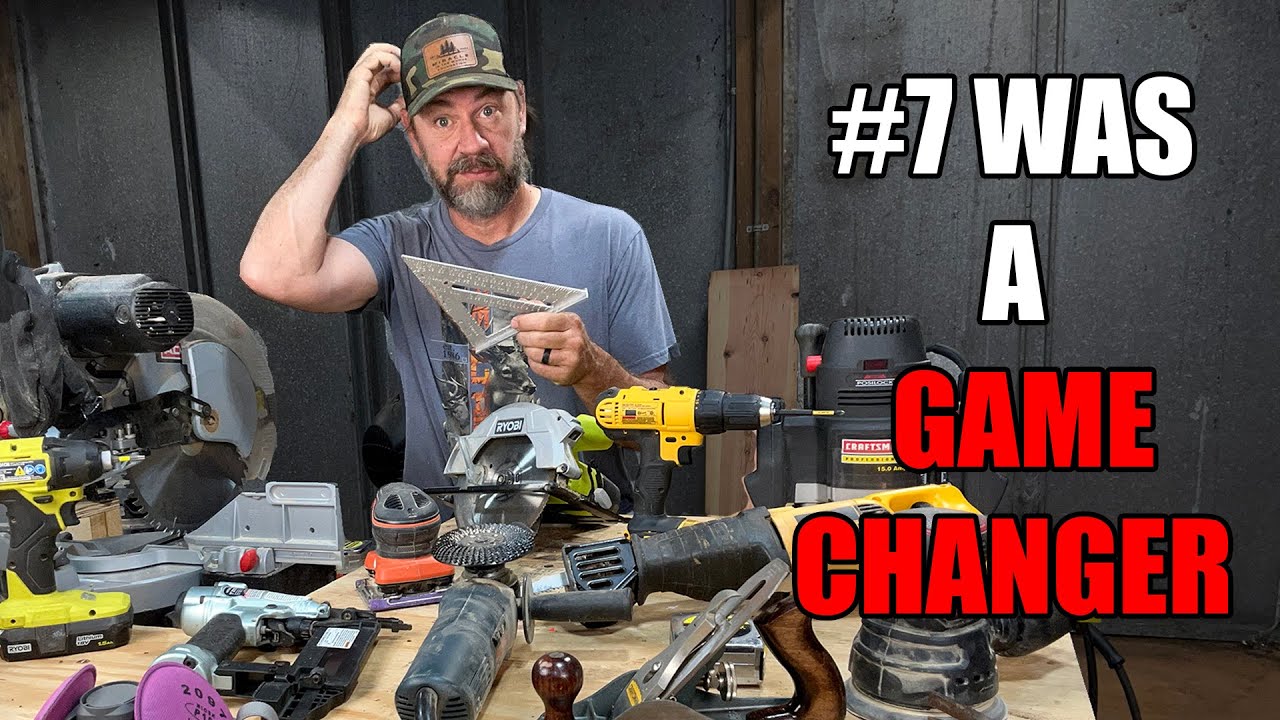
9 Woodworking Tools I Use All the Time as a Beginner Woodworker
When I first started planning this article, I was going to call it something like 9 Essential Tools for Beginning Woodworkers.
But the more I thought about it, the more that title bothered me.
Because I don’t want anyone thinking they have to go out and buy all nine of these tools before they can build their first woodworking project. That is absolutely not the case.
Plenty of people have started woodworking with nothing more than a circular saw and a drill. Some probably started with a handsaw and a drill. You can build a surprising number of projects with very few tools if you’re willing to keep things simple and work within what you have.
In fact, a small project like a kids’ picnic table, a basic planter box, or a simple outdoor project can often be built with just a saw, a drill, a tape measure, and a little patience.
That said, as you grow as a woodworker and start taking on more projects, there are certain tools you’ll find yourself reaching for over and over again.
These are the nine woodworking tools I use on just about a daily basis in my shop. They’re not necessarily listed in the order I would buy them, and they’re not all equally important for every person. But if you’re just getting started, these are the tools I’d start putting on your radar.
1. Miter Saw
The miter saw was my first real woodworking power tool purchase.
And when I say “purchase,” I don’t mean I went out and bought some fancy professional model. I bought an old Black & Decker miter saw off Facebook Marketplace for about $25.
It was basic. Very basic.
It would make 90-degree cuts and could only handle boards up to about 6 inches wide. But it worked, and it helped me get started.
Eventually, I was able to borrow my father-in-law’s sliding compound miter saw, which was a major upgrade. His saw can cut wider boards, handle bevel cuts, make miter cuts, and slide forward to cut boards up to about 12 inches wide.
A miter saw is mainly used for crosscuts — cutting boards to length. It’s also useful for angled cuts, bevels, trim work, and a whole lot of basic project building.
For a beginner woodworker, a miter saw is one of those tools that can make projects feel a lot more manageable.
Can you get by without one? Yes.
Can you use a circular saw instead? Also yes.
But if you’re building a lot of projects with dimensional lumber, cedar fence pickets, planter boxes, benches, tables, or simple furniture, you’ll probably find yourself wanting a miter saw sooner rather than later.
And if you’re on a budget, don’t overlook Facebook Marketplace, yard sales, flea markets, and used tools. You don’t have to buy new right out of the gate.
2. Power Drill
A power drill is one of those tools you’ll need from the very beginning.
Pair a drill with a circular saw or miter saw, and you can build a lot of basic woodworking projects.
A drill lets you:
- Drill pilot holes
- Drive screws
- Attach hardware
- Assemble frames
- Build outdoor projects
- Install hinges, hooks, brackets, and other parts
You’re also going to want a decent bit set to go with it.
Cordless drills are great, and they’re definitely convenient. But if you’re trying to get started on a tight budget, don’t be afraid to buy a corded drill.
Corded tools aren’t as trendy as battery-powered tools these days, but they still work. And if you’re working in a shop, garage, or carport where outlets are nearby, a corded drill can get you started for a lot less money.
You can often find used corded drills for $20 to $30, and that may be all you need in the beginning.
Battery-powered tools are nice, but once you start adding batteries and chargers, the price climbs pretty fast.
3. Table Saw
The table saw is where a lot of debate starts.
Some woodworkers would tell you to buy a table saw before a miter saw. Others would say the miter saw should come first.
For me, the miter saw came first. But the truth is, it really depends on what kind of projects you plan to build.
A table saw is especially useful for ripping boards down to width. That means taking a wider board and cutting it into narrower strips.
I use mine a lot for cedar fence picket projects, planter boxes, squirrel feeders, birdhouses, and similar small builds.
A table saw can also be used to break down larger boards and sheet goods like plywood, depending on your setup. Cabinet makers and furniture builders use table saws constantly.
You can also build or buy jigs that allow a table saw to make certain cuts you might otherwise make with a miter saw. So there is an argument that a table saw can serve multiple purposes early on.
My table saw was another Facebook Marketplace find. I paid around $75 for a used Ryobi table saw, and it has helped me get a lot done.
If you’re buying used, you can often find beginner-friendly table saws in the $100 to $200 range. If you’re buying new, there are decent budget options around the $300 range.
I’ve heard good things about the Skil table saw, the Hercules from Harbor Freight, and some of the Kobalt tools from Lowe’s. There are a lot of options out there if you’re not ready to spend big money.
Just know this: at some point, if you stick with woodworking, you’re probably going to want a table saw.
4. Orbital Sander
If you’re new to woodworking, you’ll learn this pretty quickly:
A big part of woodworking is sanding.
Lots and lots of sanding.
If you want your projects to look finished, feel smooth, and take stain or paint well, you’re going to need some kind of sander.
An orbital sander is a great place to start.
I started with an old Black & Decker sander that I had for years. It finally died on me in the middle of a project, so I ran to Walmart and picked up a cheap Hyper Tough orbital sander for around $30.
And honestly, it has done fine.
Would I like to upgrade eventually? Sure.
I’d like to have a cordless orbital sander at some point, especially once I settle on which battery platform I want to stick with. But for now, a basic corded orbital sander gets the job done.
You don’t need the fanciest sander on the shelf to get started. You just need something reliable enough to smooth your projects and keep you moving.
5. Tape Measure
A tape measure could probably be number one on this list.
You’re going to have a hard time building anything without being able to measure your material.
At the same time, you can’t build a project with a tape measure alone. That’s why I didn’t try too hard to put this list in order of importance.
But make no mistake: you need a tape measure from day one.
And you need to learn how to read it.
Know what all the marks mean. Understand fractions. Learn how to measure accurately and consistently.
There’s a reason woodworkers say, “Measure twice, cut once.”
Your accuracy starts with your tape measure. If your measurements are off, everything after that gets harder.
6. Clamps
Clamps are one of those things I didn’t fully appreciate until I started woodworking.
Then I learned real quick:
You can never have too many clamps.
There are all kinds of clamps out there:
- F-style clamps
- Bar clamps
- Parallel clamps
- Spring clamps
- Right-angle clamps
- Small hand clamps
You don’t need every type on day one, but you are going to need clamps early.
If you’re gluing boards together, you need clamps to hold everything tight until the glue dries. If you’re assembling a project, clamps can hold parts in place while you drive screws, shoot brad nails, or check for square.
I’ve even picked up some small right-angle clamps from Amazon that are handy for holding boards at 90 degrees while assembling boxes and frames.
There are makeshift ways to get by without clamps for a while, but eventually they make life a lot easier.
Put clamps high on your woodworking shopping list.
7. Square
A square is another tool I didn’t realize I needed as much as I did.
Then once I started using one, I wondered why I waited so long.
Squares come in different shapes and sizes, and you’ll probably end up with several if you stick with woodworking. But if you’re just getting started, pick up a simple speed square.
They’re cheap, easy to find, and incredibly useful.
A speed square helps you:
- Check 90-degree corners
- Mark straight cut lines
- Mark 45-degree angles
- Check basic layout
- Keep boxes and frames square
I bought one from Harbor Freight for less than $4, and it’s one of the best cheap tools you can add to your shop.
If you’re building a box, frame, planter, table, or anything with corners, a square helps you make sure those corners are actually square.
That matters more than you think.
A speed square is a less-than-$10 insurance policy against crooked projects.
8. Brad Nailer
A brad nailer is not something I’d call an absolute necessity for every beginner woodworker.
But I do use mine a lot.
How useful it is depends on what kind of projects you’re building.
If you’re making small projects like planter boxes, birdhouses, squirrel feeders, trim pieces, small shelves, or cedar fence picket projects, a brad nailer is extremely handy.
It lets you tack pieces together quickly without having to clamp and screw every single joint.
But if you’re mostly building heavier furniture or projects that rely on screws, bolts, or more advanced joinery, a brad nailer may not be as high on your priority list.
My brad nailer is air-powered, which means it needs an air compressor. You can also buy battery-powered brad nailers, which are more convenient but usually more expensive.
For the kind of projects I’ve been building, I reach for the brad nailer pretty regularly.
9. Air Compressor
If you use air-powered tools, you’ll need an air compressor.
My air compressor is a McGraw model from Harbor Freight. It’s not fancy, but it works.
An air compressor can be useful for more than woodworking. You can use it to air up tires, blow dust off tools, run nail guns, and handle other jobs around the shop or house.
For woodworking specifically, the main reason I use mine is to run my brad nailer.
You don’t necessarily need a large compressor if all you’re doing is running a nail gun. One of the smaller pancake-style compressors can work fine for that.
If you plan to spray paint or run tools that require a lot more air, then you’ll need to look at a bigger compressor.
If I were ranking these tools strictly by importance, the air compressor would probably be lower on the list. But since I use an air-powered brad nailer, my compressor gets used a lot.
Bonus: Don’t Forget Safety Gear
I probably should have called this article 10 Tools for Beginner Woodworkers, because I don’t want to leave out safety gear.
Do not start woodworking without basic PPE — personal protective equipment.
At a minimum, you need:
- Eye protection
- Hearing protection
- A dust mask or respirator
Protecting your eyes is non-negotiable. Wood chips, dust, and little pieces of material can fly faster than you can react.
I use safety glasses, and I’ve even found some that have readers built into the bottom. If you’ve got older eyes like I do, those are pretty handy.
You also need hearing protection, especially when using loud tools like a miter saw, table saw, circular saw, or planer. I found out pretty quickly that planers are no joke when it comes to noise.
And then there’s dust.
Most beginner woodworkers don’t have a fancy dust collection system, which makes a good mask even more important.
An N95 mask is better than nothing, but a proper respirator with P100 filters is a better option for fine dust. That fine dust is not something you want in your lungs.
You don’t want to damage your eyes, your hearing, or your lungs just trying to build a planter box.
Buy the safety gear.
Use it.
So, Which Tools Should You Buy First?
That depends on what you want to build.
If you’re trying to get started as cheaply as possible, I’d probably begin with:
- A saw of some kind
- A drill
- A tape measure
- A square
- Safety gear
From there, add tools as your projects require them.
If you’re building a lot of small outdoor projects, a miter saw, orbital sander, clamps, and brad nailer will quickly become useful.
If you’re ripping boards, working with plywood, or building furniture, a table saw will move higher on the list.
The main thing is this:
Don’t let a lack of tools keep you from starting.
Buy what you can afford. Borrow when you can. Shop used. Upgrade later.
You don’t need a dream shop to build your first project. You just need enough tools to get started and the willingness to learn as you go.
That’s where I am right now.
I’m still learning, still figuring out what I need, and still trying to build this woodworking journey one project at a time.
And if you’re just getting started too, hopefully this list helps you know what tools are worth looking at first.
Products Mentioned
Below are some of the types of tools mentioned in this article. These are good places to start if you’re building out your first woodworking setup.
- Miter saw
- Power drill
- Table saw
- Orbital sander
- Tape measure
- Woodworking clamps
- Speed square
- Brad nailer
- Air compressor
- Safety glasses
- Hearing protection
- Respirator or dust mask
Watch the Video
Affiliate Disclosure
Some of the links above may be affiliate links, which means I may earn a small commission if you make a purchase through those links. It doesn’t cost you anything extra, and it helps support the projects we’re working on here at Grossman Woodworking and DIY.